Find out what AI can actually run on
in your organization. In three weeks.
Many of your people are already using AI with customer or student data. The AI Readiness Assessment tells you what is exposed, what to automate first, and what it is worth. Fixed fee of $7,500, with a roadmap you own whether or not you hire us again.
One price. One decision. No procurement.
Most AI projects stall before they start because nobody can say what the data looks like, who is already using which tools, or which of the twelve ideas on the whiteboard would pay for itself. The assessment answers those three questions in writing, in three weeks, for a fee a single leader can approve.
It is built for two kinds of organizations: Michigan charter school networks and authorizers whose boards need an AI policy, a gap list, and a plan their existing staff can run, and privately held or PE-backed manufacturers in the $20M to $300M range whose staff got to AI before the policy did.
- $7,500, fixed. The fee on this page is the fee on the invoice.
- Two to three weeks from kickoff to readout
- Four to six hours of your team's time, total
- The people who scope the work deliver it.
$7,500
Fixed fee. Two to three weeks. Delivered as a written report, a board or leadership readout, and a 90-day roadmap.
- Data and systems inventory
- AI governance gap list
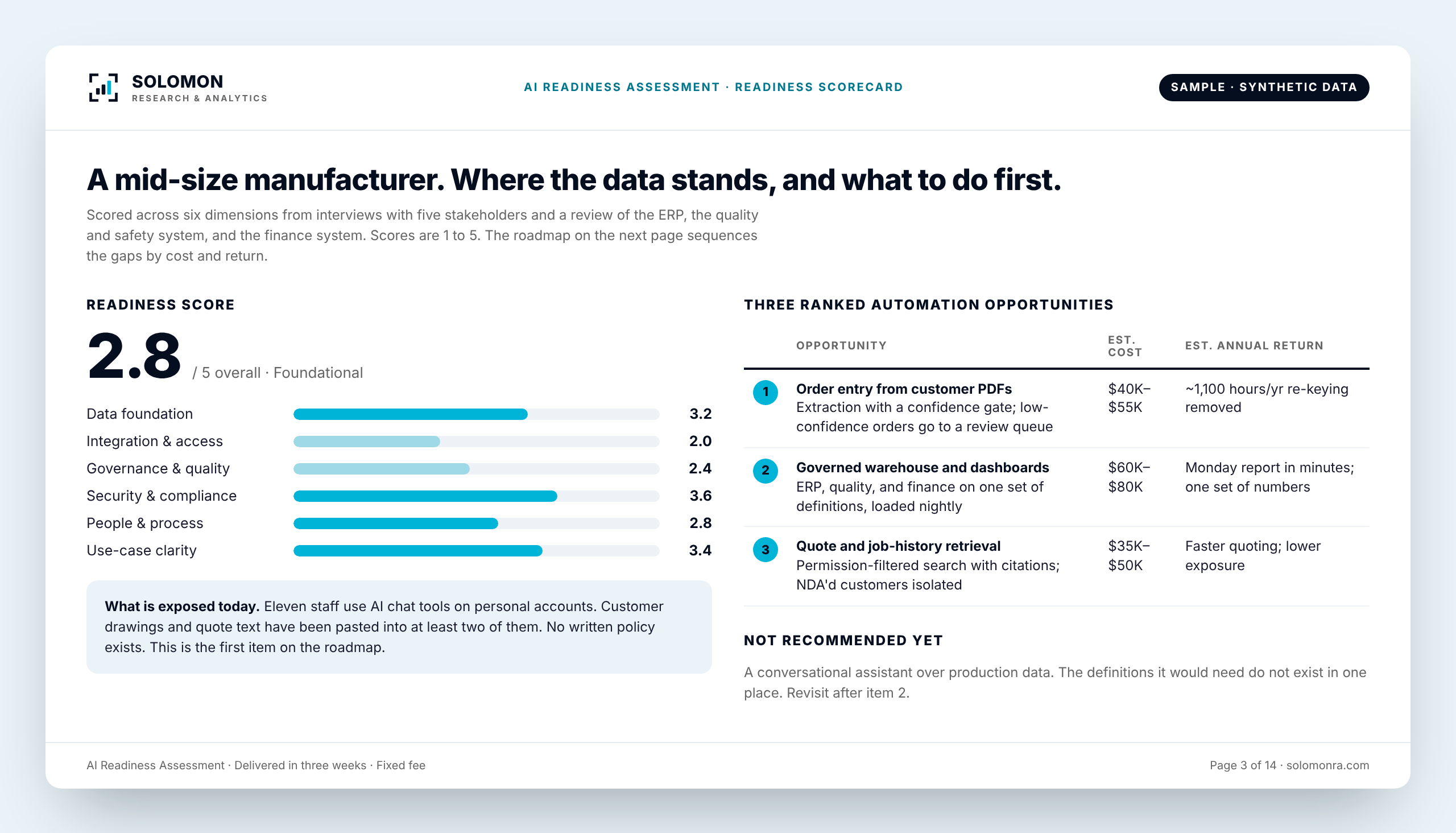
- Three ranked automation opportunities, each with ROI
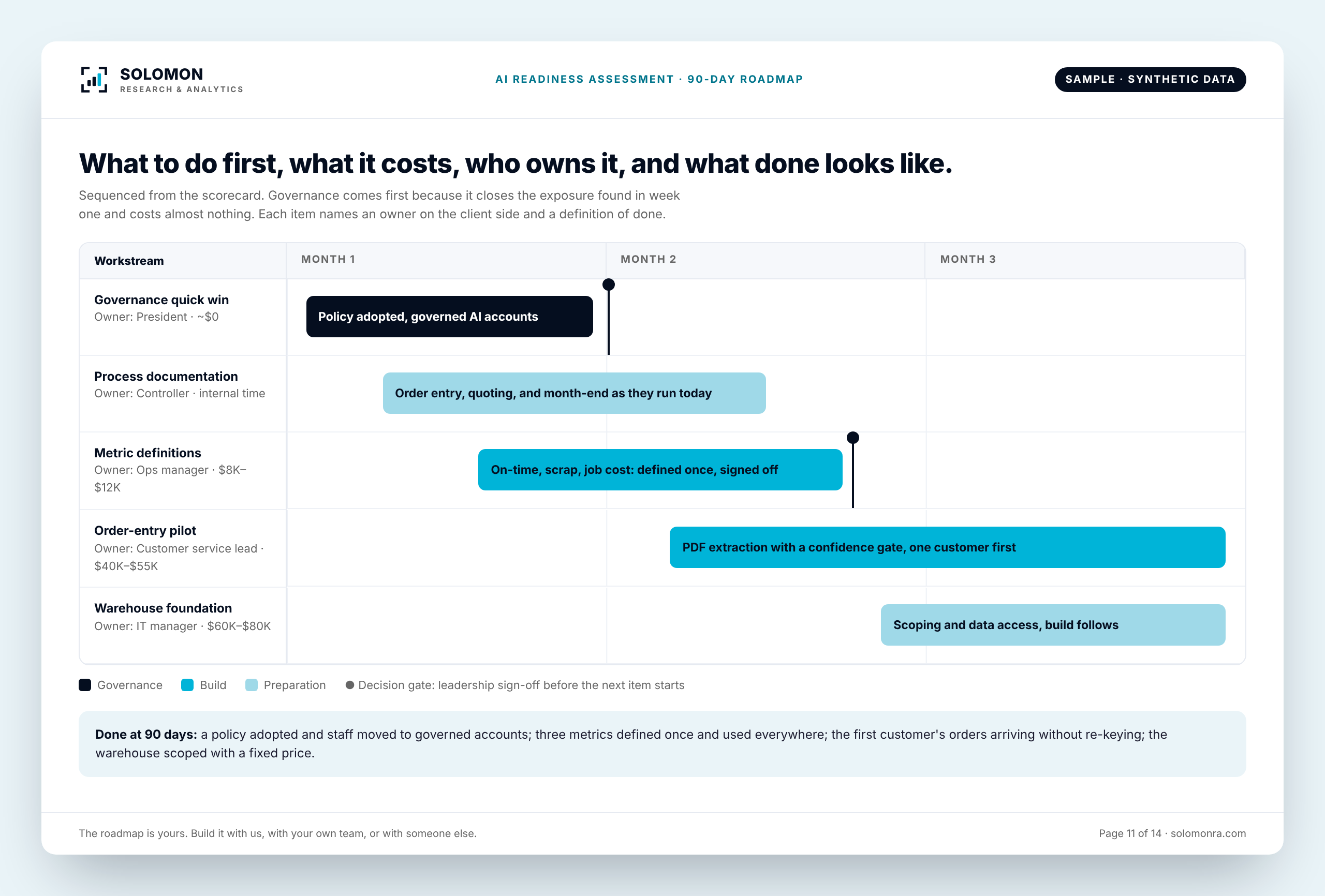
- 90-day roadmap with costs and sequence
- Readout for your board or leadership team
Prefer email? joe@solomonra.com
Four deliverables. Each one is something you can act on the day you receive it.
Data and systems inventory
Every system that holds data that matters: ERP or student information system, finance, CRM, scheduling, assessment, and the spreadsheets nobody admits to. Who owns each one, what it connects to, and how trustworthy the numbers in it are.
AI governance gap list
Where your current practice falls short of the standard you are measured against. For charters, student data protection and the AI policy your board is accountable for. For manufacturers, the customer contracts and NDAs you signed. Written so a board can read it.
Three ranked automation opportunities
The three places AI or plain automation would save the most hours or risk, ranked, with an estimated cost to build and an estimated annual return for each. Not twelve ideas. Three, in order.
90-day roadmap
What to do first, what it costs, who does it, and what "done" looks like. The roadmap is the proposal for whatever comes next, whether you build it with us, with your own team, or with someone else.
Two kinds of organizations.
The same three questions.
Charter school networks and authorizers
Your staff are already using AI with student data and your board is accountable for it. The assessment gives the board the gap list, the policy outline, and the dashboard plan it has been asking for, timed to the November and December budget amendments or the FY28 budget.
Data and AI for charter schools →Privately held and PE-backed manufacturers
You are mid-way through an ERP reimplementation, the one person who knows the data is retiring, a customer just sent a new data security requirement, and your staff are already pasting quotes into personal AI accounts. The assessment tells you what is exposed, what to automate first, and what it is worth.
AI and data for Michigan manufacturers →Three weeks, start to readout.
One kickoff, a handful of interviews, a written report, and a readout. Nothing in it needs a procurement process.
Week 1. Kickoff and interviews
A 60-minute kickoff with the decision maker, then four to six short interviews with the people who own the systems and the people already using AI. We request access to the systems we need to see, and nothing more.
Week 2. Review and analysis
We build the inventory, test data quality where it counts, map current practice against the governance standard, and cost out the automation candidates. Your team's involvement this week is answering the occasional email.
Week 3. Report and readout
You get the written report two days before the readout so nobody is reading it for the first time in the room. The readout is 60 to 90 minutes with your leadership team or board, in person in Michigan or over video.
After. The roadmap is yours
Every item on the 90-day roadmap has a cost and an owner. If you want us to build the first one, the roadmap is already the proposal. If you want to run it yourself or with another vendor, it works just as well for that.
The assessment is the first step,
not the whole staircase.
Most assessments turn into one of these. The roadmap prices whatever comes next, so you have a fixed number for the first phase before you decide anything, and there is never a second discovery phase.
Board dashboard
Enrollment, finance, and academic growth in one place, refreshed without anyone exporting anything. Built to the questions your board actually asks.
Data platform and AI maintenance
A governed data warehouse across the student information, finance, and assessment systems, with the AI-assisted analysis and ongoing maintenance that keeps it current.
Automation pilot
A six-week build of the top-ranked opportunity, with a defined outcome. Order entry and quoting automation are the most common first picks.
Warehouse and AI deployment
A governed data warehouse over the ERP, quality, and scheduling systems, with dashboards and private AI deployed inside your own environment.
What leaders ask
before they book.
What does the AI Readiness Assessment cost, and is the price really fixed?
The fee is $7,500, fixed, and it covers everything listed on this page. It does not change if the assessment takes a few more hours than we planned. The number is on the website so that one decision maker can approve it without a procurement cycle.
How long does it take?
Two to three weeks from kickoff to the readout. Your team's time is roughly four to six hours in total: a kickoff, a handful of short interviews, and the readout meeting.
Who needs to be involved on our side?
The person who owns the decision, the person who knows where the data lives, and whoever is already using AI tools day to day. In a charter network that is usually the CEO or superintendent, a finance or operations lead, and one principal. In a manufacturer it is usually the owner or president, the controller, and the IT manager.
Do we have to buy anything afterward?
No. The roadmap is yours. Some clients run it themselves, some bring it to another vendor, and some ask us to build the first item. Every recommendation names what it would cost and what it is worth, so you can make that call with real numbers.
We already have staff using AI chat tools on their own. Does that count as being ready?
It usually counts as the reason to do the assessment. Individual accounts, customer or student data in prompts, and no written policy is the most common pattern we see. The assessment tells you what is exposed and what a workable policy looks like for an organization your size.
Does the assessment cover AI governance and policy?
Yes. For charter schools and networks, the governance section inventories the AI tools in use, checks how student data is handled, and gives the board a gap list and a policy outline it can act on. For manufacturers, the same section covers the customer contracts and NDAs that govern your data instead.
Can you do this remotely?
Yes. Most of the work is interviews and system review, which run well over video. We are in the Lansing area and will come on site for the kickoff or readout when it is useful, at no extra charge inside Michigan.