Your staff are already using AI with student data.
Here is what it takes to govern it.
Individual accounts, student data in prompts, and no written policy is the most common pattern we see. We turn that into a gap list, a policy your board can adopt, and the dashboard it has been asking for, in 90 days, starting with a three-week assessment a single leader can approve.
AI is already in the building. The policy is not.
Nationally, 79 percent of districts now report having AI guidelines, but only 56 percent have an acceptable-use policy (CoSN, State of EdTech 2026). What most networks still do not have is anyone whose job it is to inventory the tools staff already use, write the policy, protect student data in prompts, and report progress to the board on schedule.
The calendar helps if you use it. November and December budget amendments can fund an assessment now. The FY28 budgets you build between January and May can fund the dashboard or platform the assessment recommends. We scope proposals around that calendar so the board votes once, with real numbers.
- An inventory of the AI tools your staff already use, and with what data
- A governance gap list, written for a board
- A policy outline your board can adopt at its next meeting
- The three automations or reports worth doing first, with costs
How Charter Networks Work With Us
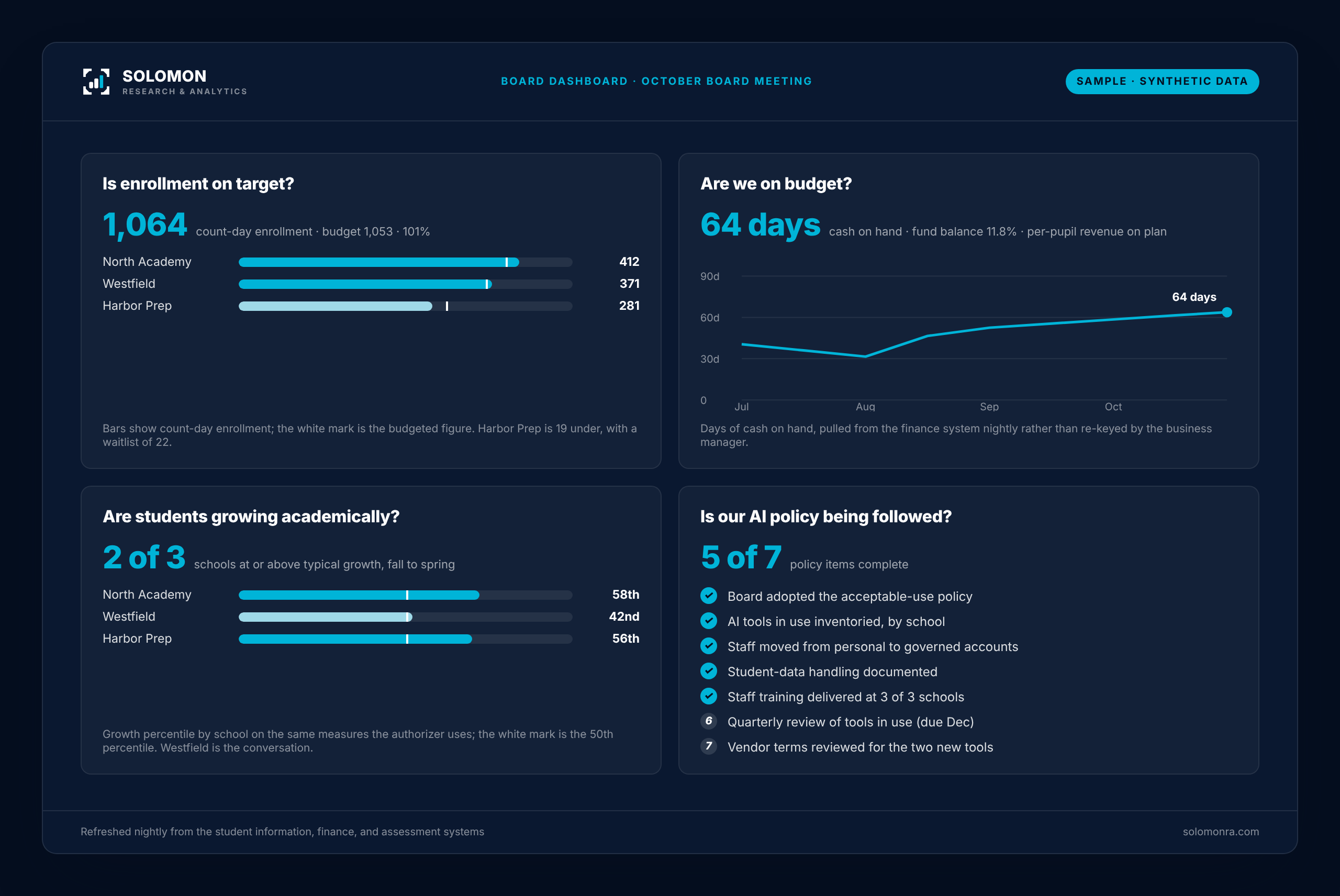
Four questions, answered on one screen, before every board meeting.
A board dashboard is not a prettier version of the authorizer's report. It is built for the decisions your board makes.
Is enrollment on target?
Count-day projections against budget, by school and grade, with the waitlist and withdrawal trend that explains the gap before anyone asks.
Are we on budget?
Cash position, fund balance, and per-pupil revenue against the amended budget, pulled from your finance system rather than re-keyed by the business manager.
Are students growing?
Growth and achievement by school, subgroup, and cohort, on the same measures your authorizer uses, so there are no surprises at renewal.
Is our AI policy being followed?
Policy adopted, tools inventoried, staff trained, data protected: a live status the board can see rather than a memo it has to request.
We have done this for the people
who hold charter schools accountable.
A university charter authorizer
Growth and achievement analysis across a university charter authorizer's portfolio, built from the data it already had, so staff can answer a board or field question without pulling an analyst off everything else.
Read the case study →A statewide charter commission
Analysis and reporting for a statewide charter commission, delivered exactly as proposed, with the charter process knowledge that meant nobody had to explain what a renewal was.
FERPA compliance analysis
Student data handling reviewed against FERPA for an authorizer client, the same lens we bring to the AI tools your staff are using today.
Ten years of charter evaluation
Before Solomon, our founders ran research and analytics for a university authorizer and evaluated charter schools across Michigan. That is why the first month of an engagement is spent on your data, not on explaining the sector to us.
For authorizers specifically →What charter leaders ask us
about AI governance.
What does responsible AI use actually require of a charter school?
Adopt a policy, inventory the AI tools in use, protect student data, train staff, and review progress on a schedule the board can see. None of that comes with staff or a budget line. The AI Readiness Assessment turns it into a gap list and a plan your existing team can carry out.
We are a small network. Is this built for us?
Yes. Our charter work has included single-site academies, multi-school networks, and the largest authorizer in Michigan. The assessment is sized for one decision maker and a $7,500 fee, which is inside most networks' discretionary authority and fits the November and December budget amendments.
Can this be paid for from the FY28 budget?
The assessment can be paid now, from a budget amendment, and the board dashboard or platform that follows can be built into the FY28 budget you draft between January and May. We structure proposals around that calendar on purpose.
Our authorizer already gives us performance reports. What is different?
Authorizer reports are built for the authorizer's accountability decision. A board dashboard is built for yours: enrollment against budget, cash position, staffing, and academic growth, refreshed without anyone exporting a file. The two should agree, and part of our job is making sure they do.
Does Solomon understand charter accountability, or will we spend the first month explaining it?
Between us we have spent careers in charter school evaluation, authorizer accountability, and education policy, including ten years of charter evaluation work and ongoing performance analysis for a Michigan university authorizer. You will not have to explain what a renewal cycle is.
What happens to our student data during an assessment?
We work from access that you provision and can revoke, we do not move student records into any AI tool, and we document the data handling in the report itself so your board can see it. FERPA compliance analysis is part of our prior work for authorizers and commissions.